Haig Point Club has become a premier destination for members with its 29 golf holes, tennis and fitness facilities, swimming, and beach recreation.
Photo by Dennis Burnett Photography.
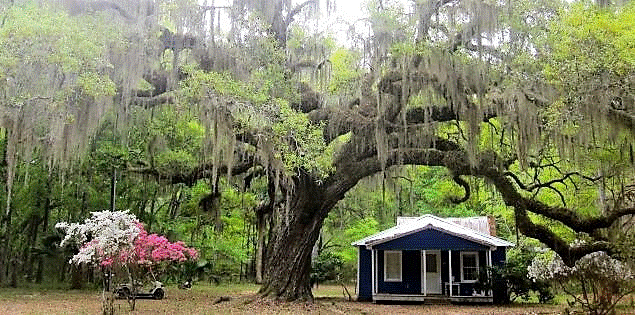
The Club boasts less than 300 homes situated on 1,050 acres making plenty of room for members to enjoy an active and outdoor low country lifestyle. By working with local contractors and builders Haig Point has been able to preserve the beauty of Daufuskie Island as well as many of the historical aspects for future generations.
Photo by Dennis Burnett Photography.
Haig Point offers a more intimate lifestyle with all the amenities you expect…and more unique features few private communities can offer; empty beaches, a fabulous top-ranked Rees Jones-designed golf course, an equestrian center, and a safe, healthy and secure family environment. Whether you croquet at the Strachan Mansion, fly fish, cast for shrimp or crab, take a sunset cruise or enjoy an event at the Club, Haig Point offers a rich and fulfilling lifestyle. It’s not opulent, stuffy or fabricated, but welcoming and undeniably authentic.
Photo by Dennis Burnett Photography.
One of the many charms of Daufuskie Island’s Haig Point is that it is accessible only by boat. You arrive here from Hilton Head Island, SC by a scenic ferry ride from the private Haig Point embarkation center (18 round trips run each day) or a 24-hour water-taxi service from Harbour Town. The personal touch points of concierge services, like grocery and package delivery from the mainland, make island living second to none. Haig Point is a car-free island paradise that is blessed with natural beauty and void of noise pollution. When you live at Haig Point, you can be as active or laid back as you choose. But know that the social scene is lively and has a magical way of engaging the entire family.
Photo by Dennis Burnett Photography.
Haig Point has 29 championship holes to challenge any level golfer. Prefer horses? Our equestrian center is outfitted to meet the needs of your horses, and lessons are offered to those looking to become riders. As for tennis enthusiast, we have six Har-Tru® tennis courts with USTA’s “Outstanding” rating. The opportunities for outdoor adventure are endless!
Photo by Dennis Burnett Photography.
Words and photos cannot fully describe the attraction of the Haig Point community. It’s a connection you get from the moment you arrive. Something each of our members experienced first-hand. They were drawn to Daufuskie Island for its character and ultimately chose Haig Point for the magical bond. But is it for you? There’s only one way to know.
Photo by Dennis Burnett Photography.
The natural beauty of Daufuskie Island shines through each and every property in Haig Point. Our beaches showcase the glistening water of the Atlantic Ocean with a backdrop of South Carolina at its finest. We specially develop each plot of land to enhance its natural beauty and work with local companies who understand how to complement what Mother Nature has given us.
Photo by Dennis Burnett Photography.
Although there are a few cars on Daufuskie, golf carts are the main mode of transportation. Which is not only better for the earth, but also better for your soul. The lack of transportation noise only enhances the peaceful stillness around the island.
Photo by Dennis Burnett Photography.
If the outdoors is where enjoy spending most of your time, Haig Point offers fishing (deep sea and along the banks), crabbing, water sports, bike rentals, Bocce ball, and kids’ camp. The lifestyle here on Haig Point on Daufuskie Island is truly what you make it. There are exceptional classes and lessons to mold a unique variety of activities which you enjoy participating.
Photo by Dennis Burnett Photography.
The Haig Point lifestyle is simply incomparable. There are less than 300 homes on 1,050 acres. Within the 1,050 acres of our private island community, there are three clubs, 29 holes of golf, tennis, fitness, swimming, and beach recreation. Haig Point Club is more than just a place to live, it’s a community of people who grow and truly share life together. Our community buildings allow you to build lasting relationships with other residents through a wide variety of activities. We invite you to visit and get to know more about our members.
Take a trip across the Lowcountry to visit these historically significant spots.
Today’s Green Book of South Carolina pays homage to the original Green Book by highlighting African American heritage sites across the state. The original Green Book was published in 1936. It played a critical role in protecting African American travelers by providing information on safe travel and welcoming establishments across the United States. This guide was instrumental in helping black motorists navigate the dangers of racial segregation. It included gas stations, restaurants and lodging that were safe for African American travelers.
Calvin Ramsey has revived the Green Book as a guide to historically significant sites. The South Carolina Lowcountry counties of Beaufort, Colleton, Hampton and Jasper are very fortunate to have 36 sites memorialized in the Green Book of South Carolina. The following sites were shared from https://greenbookofsc.com/.
BEAUFORT “Freedom Along the Combahee”: Combahee Ferry Raid Hwy 17 at Combahee River, Beaufort County A Union force consisting of nearly 300 members of the 3rd Rhode Island Artillery and the 2nd S.C. Volunteer Infantry, an African American unit, raided several plantations along the Confederate-held Combahee River on June 1-2, 1863. Col. James Montgomery led the expedition. The famed Underground Railroad conductor Harriet Tubman also participated. More than 700 enslaved men, women, and children were freed. Some of the freedmen enlisted in the U.S. Army.
Photo by Terry Kearns
Berean Presbyterian Church / J.I. Washington Branch Library 602 Carteret St. Beaufort Samuel J. Bampfield, an influential African American political figure during Reconstruction, was the founder of Berean Presbyterian Church. He served as postmaster, clerk of the Beaufort County court, and a member of the South Carolina House of Representatives. The congregation purchased this lot in 1892 and built a Gothic Revival style church. Solomon P. Hood, a future U.S. Minister to Liberia, was appointed as its first pastor. The Beaufort Township Library purchased the building in 1931 and used it as a segregated library for African Americans. After the desegregation of the Township Library, the segregated branch closed. Later, the Neighborhood Youth Corps used the building as its headquarters. USC-Beaufort purchased the site in 1993 for use as an art studio.
Camp Saxton Ribaut Rd. on the US Naval Hospital Grounds, Port Royal The Camp Saxton Site is nationally significant as an intact portion of the camp occupied from early November 1862 to late January 1863 by the 1st South Carolina Volunteers, the first black regiment mustered into regular service in the United States Army during the Civil War, and as the site of the elaborate ceremonies held here on New Year’s Day 1863 which formally announced and celebrated the enactment of the Emancipation Proclamation freeing all slaves in areas then “in rebellion” against the United States. This area is preserved as part of Reconstruction Era National Historical Park. However, it is located on the campus of the Beaufort Naval Hospital, an active duty military installation. As a result, this area is not currently open to public access.
Detreville House 701 Green St. Beaufort Rev. James Graham built this house c. 1785. It became known as “the Mission” during Reconstruction, when Mrs. Rachel C. Mather of Boston occupied the house. She and other Baptist missionaries built Mather School in Beaufort to educate African Americans. The house is included in the Beaufort Historic District.
First African Baptist Church, Beaufort 601 New St. Beaufort This church, founded in 1865, grew out of an antebellum praise house for black members of the Baptist Church of Beaufort. During the Civil War, after the Federal occupation of the town, it hosted a school for Freedmen. Rev. Arthur Waddell (1821-1895), organized the church with two fellow black ministers in 1867. Robert Smalls (1839-1915), Civil War hero, state legislator, and U.S. Congressman, was its most prominent member.
Image found on the Green Book of SC website.
Grand Army of the Republic Hall 706 Newcastle St. Beaufort Although Beaufort’s black military companies remained active after the Civil War, statewide the “Negro militia” rapidly declined during the 19th century. By 1903, the only units left were two companies in Beaufort. Many black Union veterans lived in the community, and after the war they formed the David Hunter Post #9 of the Grand Army of the Republic, an organization for veterans of the Union Army. Built in 1896, this meeting hall for the post is believed to be the only surviving building in South Carolina associated with the Grand Army of the Republic. It is included in the Beaufort Historic District.
Mather Museum and Interpretive Center 921 Ribaut Road, building #1, Beaufort This interpretive center chronicles the history of Mather School in Beaufort, a boarding school for freed African American females. The institution was founded in 1868 by Boston schoolteacher Rachel Crane Mather, and is one of many post-Civil War developments that sought to educate recently emancipated African Americans. It first served elementary school-age girls. In 1910, high school grades were added, and in the 1950s, it became a junior college. Today, the museum is housed in the historic school’s former library, and the campus is the site of the Technical College of the Lowcountry. Moor Hall (pictured below,) one of the campus’ original historic buildings, housed classrooms, served as an administration building, a science laboratory, a library and a bookstore. The school of cosmetology training was housed in the basement.
Tabernacle Baptist Church 907 Craven St. Beaufort The Tabernacle, a meeting house and lecture room, was built by Beaufort Baptist Church in the 1840s. In 1863, Tabernacle Baptist Church was organized by Solomon Peck of Boston with most of the 500 African American members of the congregation coming from Beaufort Baptist Church. The new congregation acquired this building for their worship services. The church was rebuilt after it was damaged by the hurricane of 1893. A bust of Civil War Hero Robert Smalls is on the church grounds. Tabernacle Baptist Church is included in the Beaufort Historic District.
Wesley Methodist Church, Beaufort 701 West St. Beaufort This church, established in 1833, was the first Methodist church in Beaufort and was founded as a mission to slaves and free blacks here and on the neighboring sea islands. The congregation had both black and white members but many more black members in the antebellum era. This church, first built in the “meeting house” form common to the Methodist church, was dedicated in 1849. In 1861, after the Federal occupation of Beaufort and the sea islands, this church hosted a school for Freedmen. Its first black minister was appointed in 1873 during Reconstruction.
Image from SC Historic Properties Record.
BEAUFORT SEA ISLANDS Coffin Point Plantation Seaside Rd. St. Helena Island Coffin Point Plantation, a prosperous sea island cotton plantation, became a hub of activity when St. Helena Island was captured by Union troops in 1861. With the Union occupation of the island, the Coffin family fled, and 260 slaves were left behind. The United States government developed a plan to train and educate the newly released slaves to prove their effectiveness as free laborers. This effort became known as the Port Royal Experiment.
Dr. York Bailey House US Hwy. 21 St. Helena Island This house was built c. 1915 for Dr. York Bailey, St. Helena Island’s first African American doctor and its only physician for more than 50 years. Bailey ordered the parts for the house from a mail-order catalog and they were shipped to Beaufort, then brought across to the island by boat. The house is a good example of the vernacular American Foursquare house form. Bailey, born on St. Helena in 1881, graduated from Penn School and Hampton Institute and studied medicine at Howard University. He returned to the island in 1906 to practice medicine.
Image found on Green Book of SC website.
Eddings Point Praise House On Eddings Point Drive, .1 miles north of junction with Secondary Road 74 St. Helena Island The small wood frame building, c. 1900, is a rare example of a praise house. Praise houses were first established on plantations as places to meet and worship. Since there were few formal church buildings on St. Helena Island, most islanders could only walk or ride to the main church on Sunday mornings. For other meetings or services, they used praise houses, holding services on Sunday night and some weeknights. There were as many as 25 praise houses on St. Helena Island as recently as 1932, but only four remain today.
Emanuel Alston House Sec. Rd. 161, .25 mi. N of jct. with US 21 Frogmore/St Helena Island This house is an intact and significant example of a one-story hipped roof house, an early 20th century vernacular architectural form common to St. Helena Island. It was built c. 1915 by Tecumseh Alston, a carpenter, for his brother Emanuel. Emanuel “Mannie” Alston, born 1900, lived here until his death in 1985. He served for many years as an elder at Ebenezer Baptist Church and took a prominent part in the services there.
Knights of Wise Men Lodge Hall 14 Dr. Martin Luther King Jr. Dr. St. Helena Island The Knights of Wise Men was organized in 1870 to provide financial and farming assistance to the families of its members. The Knights purchased this property at the rear of “The Green” in 1889 for $8.00 and built a two-story wood frame building, which burned in 1940. The current concrete building was constructed shortly thereafter by local masons. It is similar in fashion to the earlier building. At its height in the 1920s, the Knights of Wise Men had some 350 members. The lodge is still used during times of celebration.
Mary Jenkins Community Praise House 355 Eddings Point Rd. St. Helena Island Mary Jenkins Community Praise House is one of only four praise houses remaining on St. Helena Island. The small wood frame building, which was built c. 1900, represents a vernacular architectural form that has survived since the plantation era. Paris Capers, born in 1863, was one of the early elders. As a place of religious worship as well as community meetings, this praise house is an important reminder of St. Helena Island’s African American heritage.
Penn Center Historic District / Reconstruction Era National Monument 16 Penn Center Cir. E. St. Helena Island Penn School was founded in 1862 by northern missionaries and abolitionists who came to South Carolina after the capture of the Sea Islands by Union troops. The site and its collection of historic buildings were venues for education, the preservation and interpretation of sea island culture, and a strategy meeting for Dr. Martin Luther King Jr. before his March on Washington in 1963. In January 2017, Penn Center and other historic sites in Beaufort County were declared the nation’s first Reconstruction Era National Monument by President Barack Obama. In 2019, the monument was officially recognized as a National Park.
Image found on the Green Book of SC website.
Robert Simmons House On unpaved road .5 mile south of US HWY. 21 St. Helena Island This house was built c. 1910 by Robert Simmons, an African American farmer. The house is a rare surviving example of a double pen house, a vernacular architectural form once common on St. Helena Island. Double pen houses had two rooms side-by-side, each usually measuring approximately 16×16 feet. The house has been enlarged, but the original core is still distinguishable.
BLUFFTON Campbell AME Church 23 Boundary Street Bluffton White Methodists built Campbell Chapel AME Church in 1853. Nine African American freedmen, who were likely once enslaved by members of the white congregation, purchased the 19th-century Greek Revival structure in 1874. Members of the new African Methodist Episcopal (AME) Church congregation immediately altered the building and expanded the site as the church thrived. They likely installed the cast-iron bell that is currently visible in the cupola. The church retains historic fabric that is both original and reflective of the change in ownership. Campbell Chapel AME continues to provide a space where congregants can educate youth, worship freely, and participate in outreach ministries. This historic church was listed in the National Register of Historic Places on April 26, 2019.
Image by Lloyd Wainscott.
HILTON HEAD Cherry Hill School 210 Dillon Rd. Hilton Head Island This one-room frame school, built ca. 1937, was the first separate school building constructed for African American students on Hilton Head Island. It replaced an earlier Cherry Hill School, which had held its classes in the parsonage of St. James Baptist Church. After the black community on the island raised funds to buy this tract, Beaufort County agreed to build this school. This was an elementary school with one teacher, with an average of about 30 students. It served grades 1-5 when it opened in 1937, adding grade 6 the next school year.
First African Baptist Church, Hilton Head Island 70 Beach City Rd. Hilton Head Island This church, founded in 1862, was originally the church in the town of Mitchelville, a Freedmen’s village established on Hilton Head by the United States Army. Rev. Abraham Murchinson, its first minister, was a former slave and the church had about 120 members when it was organized in August 1862. The church moved to the Chaplin community after the Civil War and was renamed Goodwill Baptist Church. It moved to this site by 1898 and was renamed Cross Roads Baptist Church before retaking its original name. The present church was built in 1966.
Former Home of William Simmons: Gullah Museum of Hilton Head 187 Gumtree Rd. Hilton Head Island This house, built in 1930, is typical in materials and methods of construction of those built on the sea islands from the end of the Civil War to the mid-20th century. It was built on land bought by William Simmons (c. 1835-1922), who was born a slave and served in the 21st U.S. Colored Infantry during the Civil War. His granddaughter Georgianna Jones Bryan built this house in 1930 for her brother. It illustrates everyday life and the persistence of Gullah culture in an African American farm community. It was renovated in 2010-11 as the Gullah Museum of Hilton Head Island.
Fort Howell 160 Beach City Rd. Hilton Head Island This Civil War fort, named for Gen. Joshua Blackwood Howell (1806-1864,) was built by the U.S. Army’s 32nd Colored Infantry and the 144th N.Y. Infantry to defend Hilton Head and the nearby freedmen’s village of Mitchelville from potential Confederate raids or expeditions. That village, just east of the fort, had been established by Gen. Ormsby M. Mitchel in the fall of 1862 and was named for him after his death. The fort was an enclosed pentagonal earthwork with a 23-foot high parapet and emplacements for up to 27 guns. Though Fort Howell never saw action, it is significant for its design and its structural integrity.
The Mitchelville site is preserved as the Mitchelville Freedom Park, complete with a walking trail.
Mitchelville Site Beach City Rd. Hilton Head Island After Hilton Head’s fall to Union forces in 1861, this town was planned for the area’s former slaves and named for General Ormsby M. Mitchel. It was developed into neatly arranged streets and Ľ-acre lots. The town had elected officials, a church, laws, taxes and a school for children, and was home to about 1,500 residents in 1865. The village continued relatively intact until the 1870s and was abandoned by 1890.
Queen Chapel AME Church 114 Beach City Rd. Hilton Head The AME denomination experienced rapid growth after the Civil War and Queen Chapel was among the early churches founded. In 1865, Charleston born AME Bishop D.A. Payne returned to S.C. and brought a group of missionaries to Hilton Head Island. They met with Rev. James Lynch, who had come to S.C. in 1863 to perform missionary work among the freedmen of Mitchelville.
St. James Baptist Church 209 Dillon Rd. Hilton Head Island This church, founded in 1886 by former members of First African Baptist Church, is one of the oldest surviving institutions remaining from the town of Mitchelville, a Freedmen’s village established here by the United States Army in 1862. The present brick sanctuary, covered in stucco, is the third to serve this congregation. It was built in 1972 and renovated in 2005.
Daufuskie Island Historic District 18 Simmons Rd. Daufuskie Island – Accessible only by ferry. The cotton trade spurred the growth of the slave population on Daufuskie Island from 1805-1842, and ruins of slave houses and archaeological sites remain from this period. The island was largely abandoned during the Civil War, but many former slaves returned during Reconstruction, reoccupying slave houses and building churches, schools, and meeting places. In the early 20th century, the population swelled to almost 1000, with oysters, logging, and trucking providing jobs. By the 1940s and 1950s, outside competition had caused many to leave the island and search for jobs elsewhere, leaving the population in 1980 at fewer than 75 people.
EDISTO ISLAND Edisto Island Baptist Church 1813 SC Highway 174 Edisto Island The original core of Edisto Island Baptist Church was built in 1818 to serve the island’s white planters. Enslaved African Americans attended the church with their owners, and the original slave gallery still lines both sides of the sanctuary. After Edisto Island was occupied by Union troops during the Civil War, most of the white plantation families left the island. In 1865 the trustees of the church turned it over to the black members. Edisto Island Baptist Church has operated as an African American church since that time.
The Henry Hutchinson House is in the process of a major restoration. It is being transformed into its former glory.
Hutchinson House 7666 Point of Pines Rd. Edisto Island Built by Henry Hutchinson around the time of his marriage to Rosa Swinton in 1885, the Hutchinson House is the oldest intact house identified with the African American community on Edisto Island after the Civil War. Hutchinson was born enslaved in 1860, and according to local tradition, he built and operated the first cotton gin owned by an African American on the island from about 1900-1920. Hutchinson lived here until his death in 1940.
Image found on the Green Book of SC website.
29 Seaside School 1097 SC Hwy. 174 Edisto Island This Seaside School, which was built c. 1931 as its second building, is reported to be the oldest African American school remaining on Edisto Island. From 1931 until the construction of a consolidated school in 1954, black residents of Edisto Island received their primary education in this building, a one-story, two-room rectangular frame. In 1930, the Edisto Island school district had planned to merge Seaside with Central African American school, but the community, affected by the Great Depression, could not raise enough money for the lot and school supplies. This smaller structure was built instead.
WALTERBORO Episcopal Church of the Atonement 207 Chaplin St. Walterboro This African American congregation was formed in 1892 as a mission of St. Jude’s Episcopal Church, a white congregation. The rector of St. Jude’s supplied services for the Church of the Atonement. This distinctive Gothic Revival church was built in 1896. The wood frame building features a steep gable roof. A tower on the front, which contains the Gothic-arched entrance, is decorated with fish-scale shingles and topped with an open belfry. The Church of the Atonement is included in the Walterboro Historic District.
St. James the Greater Catholic Mission 3087 Ritter Rd. Walterboro vicinity St. James the Greater Catholic Mission is an extremely rare example of a rural, southern, black Roman Catholic parish in continuous existence from its antebellum origins to today. The site includes a sanctuary, a school, and a cemetery. The sanctuary, built around 1935 in the late Gothic Revival style and entirely clad in wooden shingles, is on the same site as two previous churches built in 1833 and 1894. The schoolhouse, constructed in 1901, is rare example of a turn-of-the-twentieth-century I-house built specifically as a school for African Americans. It provided private education for local students, regardless of religious affiliation, until 1960.
St. Peter’s AME Church 302 Fishburne St. Walterboro St. Peter’s African Methodist Episcopal Church was formed in 1867 under the leadership of Rev. James Nesbitt. This building, a Gothic Revival wood frame structure, was constructed around 1870. It features Gothic windows and a tower with an open belfry. It is part of the Walterboro Historic District.
Training the Tuskegee Airmen Tuskegee Airmen Dr. Walterboro Airport During World War II, the first African Americans in the U.S. Army Air Corps graduated from the Tuskegee Army Flying School in Alabama. From May 1944 to October 1945, some of them took further combat training here, at Walterboro Army Airfield. Several of the earliest “Tuskegee Airmen,” who had already won fame in missions in Europe and North Africa, were assigned as combat flight instructors. Trainees here flew the P-39, P-47, and P-40 fighter planes and the B-25 bomber. Officers’ quarters and enlisted men’s barracks stood just east and just west of this spot, respectively.
HAMPTON Hampton Colored School Holly St., between Lightsey St. & Hoover St. Hampton This two-room school was built under the leadership of Ervin Johnson, a local African American carpenter in 1929. It served students in grades one through eight. At first funds were so scarce it was only open from October to March. Eventually however, donations from the black community allowed it to operate for a full school year. Later, high school courses were offered. This remained the only black school in town until the Hampton Colored High School was built in 1947. Then it was converted into the lunchroom for the high school. Marker erected by Hampton County Historical Society, 1989.
Image found on the Green Book of SC website.
Huspah Baptist Church and School 729 Magnolia St. W. Hampton Organized c. 1873, the congregation first met in the homes of church members before erecting a permanent sanctuary. It also began operating a school for African American students around 1890. The first school burned in 1895 (arson was suspected, but never proven). It re-opened the following year. Elizabeth Evelyn Wright and Jessie Dorsey were the first teachers at the new school. Wright would go on to found Voorhees College in 1897. The school at Huspah remained in service until the County built a new school for African American students in 1927. Marker sponsored by Huspah Baptist Church, 2015.
TILLMAN St. Matthew Baptist Church 1454 Tillman Rd. Tillman This church was founded in 1870 with Rev. Plenty Pinckney as its first minister and worshipped in a “bush tent” nearby until a log church was built a few years later. A new frame church was built on this site in the 1890s during the pastorate of Rev. C.L. Lawton. The present sanctuary was built in 1960 during the tenure of Rev. R.M. Youmans, who served here for more than 35 years. Marker erected by the Congregation, 2002.
Spending a day on the water in the South Carolina Lowcountry is always a good idea. For years, locals and visitors alike set sail with Hilton Head’s legendary Captain Fuzzy Davis of Silva Dolla Fishing Charters. Though Captain Fuzzy has since retired, his legacy lives on through the many talented fishing charter captains who continue to share a love of the sea and the warm Lowcountry welcome he was known for.
Redfish are plentiful in the waters of the South Carolina Lowcountry.
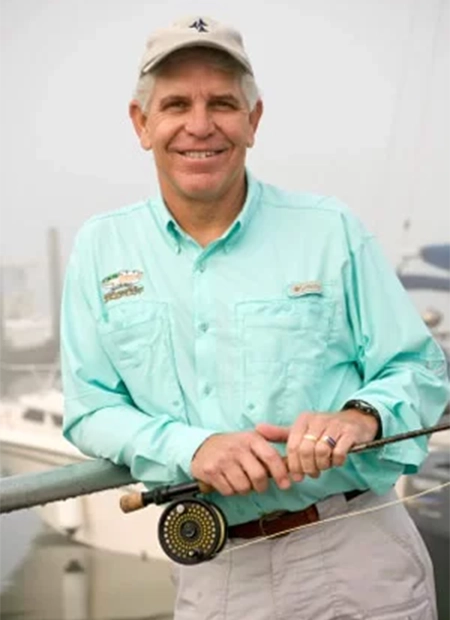
Davis fished the waters around Hilton Head for over 40 years. Featured in magazines and television shows, he’s held the South Carolina State Tarpon Record since 1986, and Saltwater Sportsman Magazine once ranked him among the “Top 50 Boat Captains in the U.S.”
Captain Fuzzy’s skill on the water and easygoing personality made him a favorite among locals and visitors. He’s the captain my family always called when it was time for a day of fishing.
Captain Fuzzy Davis
Spending a Day on the Water
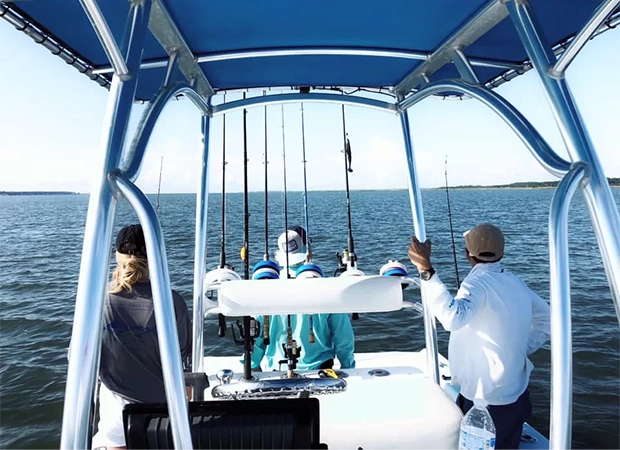
The day begins bright and early at The Boathouse dock, where Captain Fuzzy is ready and waiting. His boat is stocked with ice, bait, tackle, fishing licenses, bottled water, and plenty of fishing trivia to keep you entertained.
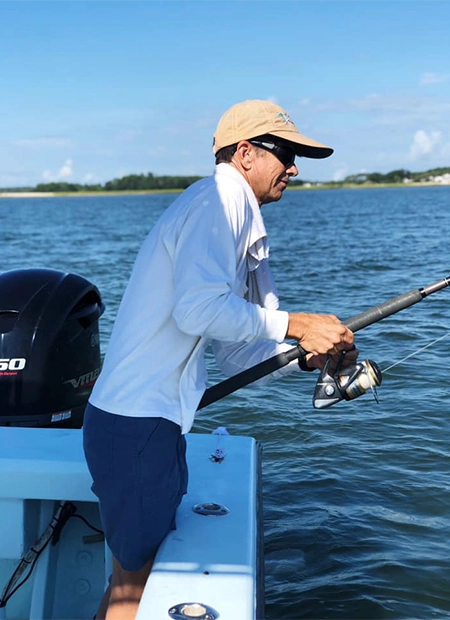
Dad gets in on the action.
After loading up, you’ll head off in pursuit of fish in the saltwater creeks, rivers, sounds, or offshore waters. Inshore excursions often focus on redfish and sea trout, while nearshore trips target tarpon, shark, redfish, trout, and cobia.
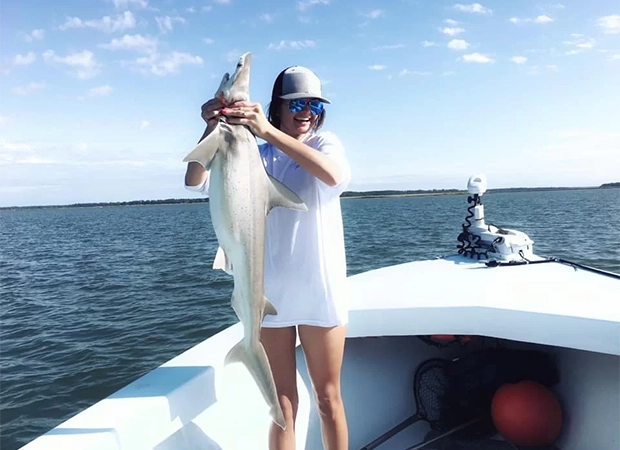
The first catch was a bonnethead shark.
The First Catch of the Day
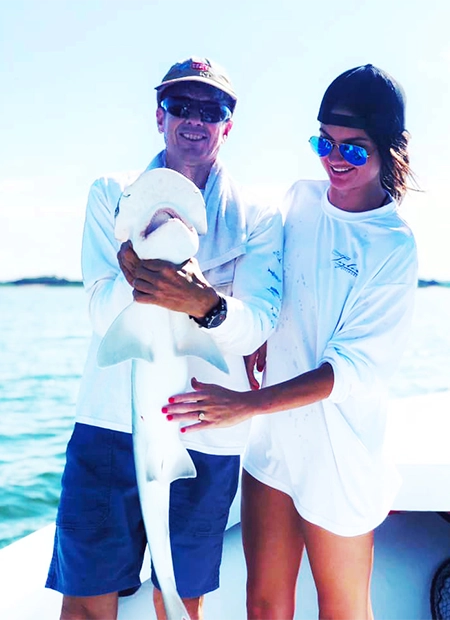
The first catch is always the most exciting. Per Dad’s request, our group started fishing for sharks and it didn’t take long before we were pulling in some beauties. This bonnethead shark put up quite the fight before being hauled on board! Bonnetheads live in subtropical waters from North Carolina to the Caribbean and typically grow between two and five feet long.
Dad and Charlotte with a Bonnethead
The proud catch!
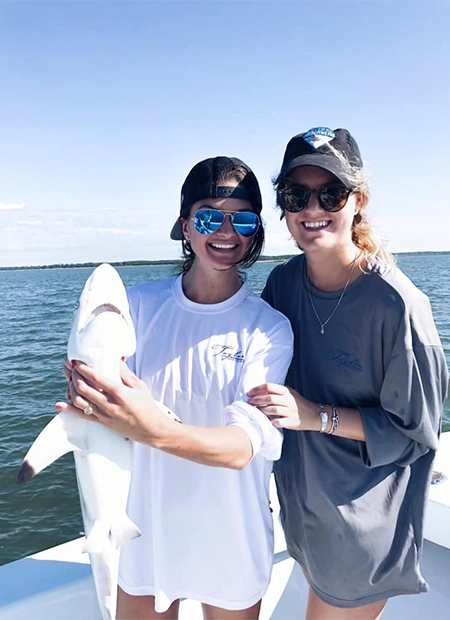
The girls with a Blacktip Shark
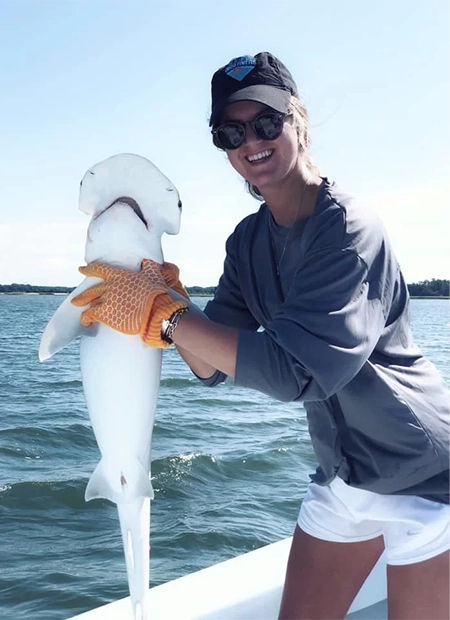
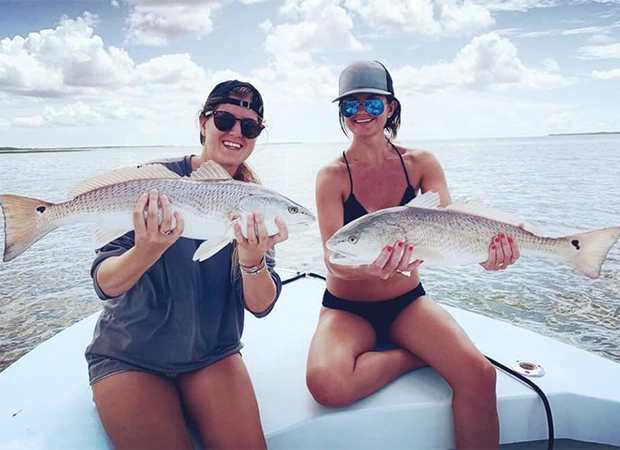
After some thrilling shark fishing, we turned our attention to redfish. The girls each hooked a prize, but the contest couldn’t be settled. One fish was longer and the other heavier, leaving the score tied and the bragging rights out on the water.
Catching redfish brings out friendly competition.
After four hours battling sharks, stingrays, and redfish, we pulled into the dock exhausted yet elated, hearts full of memories, family ties strengthened and plans for the next adventure already forming.
The team heads home after a day of fishing.
A Legacy That Lives On
Though Captain Fuzzy has since hung up his captain’s hat, his legacy lives on through the many fishing charter captains who continue to share a passion for the Lowcountry’s waters, creating unforgettable experiences for anglers of all skill levels.
Whether you’re reeling in a trophy catch or soaking in the scenery, a charter fishing trip in the South Carolina Lowcountry is more than just a day on the water, it’s a story that becomes part of your own.
Plan Your Trip
Ready to cast your line in the South Carolina Lowcountry? Explore our full list of local fishing charters in the South Carolina Lowcountry and start planning your next adventure on the water.
Frequently Asked Questions About Charter Fishing in the Lowcountry
What can I expect when charter fishing in the South Carolina Lowcountry?
Expect a day filled with sunshine, salt air, and plenty of action. Depending on your trip, you might reel in redfish, sea trout, sharks, cobia, or even tarpon, all while exploring the scenic creeks and waterways around the South Carolina Lowcountry.
Can families go on a charter together?
Absolutely! Many charters offer family-friendly trips that accommodate kids and adults, making for a memorable day on the water for all ages.
Do I need experience to go on a fishing charter?
Not at all! Charters welcome anglers of all skill levels, from first-timers to seasoned pros. The captain and crew will provide guidance and tips to help make your day successful and enjoyable.
Do I need a fishing license for a Lowcountry charter?
Yes! All anglers are required to have a valid South Carolina fishing license. Many charter services provide licenses as part of the trip but confirm with your captain beforehand to be prepared.
What should I bring on my fishing charter?
Bring non-aerosol sunscreen, a hat, polarized sunglasses, a camera, and a small cooler for drinks or snacks (unless otherwise provided). Most charters supply bait, tackle, and fishing licenses.
What’s the best time of year for a fishing charter?
The Lowcountry offers year-round fishing opportunities. Inshore trips for redfish and sea trout are popular in spring and fall, while nearshore excursions targeting tarpon and sharks peak during warmer months.
Originally written by
Carmen Pinckney
I am the Director of Online Content for the SC Lowcountry Tourism Commission. I enjoy traveling the South Carolina Lowcountry in search of fun and exciting nature-based destinations. The natural beauty found in the area between Charleston and Savannah is my world and I love sharing it with you.
Edited by
Keelie Robinson
As an avid outdoorswoman, I love hiking, camping, kayaking, boating, and traveling. Come along and we’ll explore this region, south of Charleston and north of Savannah, to find what makes the SC Lowcountry NATURALLY AMAZING!
See what our visitors love about the
SOUTH CAROLINA LOWCOUNTRY
Use the #hashtag #sclowcountry to get your image featured!
The Lowcountry & Resort Islands Region of South Carolina includes the four, southern-most counties in the state, Beaufort, Jasper, Hampton, and Colleton, which are bordered on the east by the Atlantic Ocean and on the west by the Savannah River and the state of Georgia.
Headed down the road....Edisto Island. #edisto #sclowcountry #trees #endofday #beauty #islandsofsc
Discover at your own leisure at the coastaldiscoverymuseum 🌳 From century-old buildings with storied pasts, to wooden boardwalks that stretch into the Jarvis Creek salt marsh, there`s always something to explore!
Pregnancy sleep = 😫. Silver lining, a sunrise walk with Sullie and Zoey. _ Anyone else deal with terrible sleep in the third trimester? It`s been brutal. Combo of overall anxiety/mind racing, digestion discomfort and having to pee all the time! 😐 _ #sunrise #follybeach #sclowcountry #scbeaches #goldenretrievers #goldensofinstagram #charleston #29weekspregnant #thirdtrimester #pregnancylife #pregnancyproblems #beach #beachsunrise
The shore gently recedes beneath the stunning Pawleys Island Pier. The unique island town, located about 25 miles south of Myrtle Beach and 70 miles north of Charleston, exudes laid-back, beachy vibes. Locals have definitely adopted an island state of mind and encourage visitors to as well. When you go, make sure to relax on the beach, explore the famous sand dunes, or fish in one of the many adjacent creeks.
⏰ Best time of the day to visit: We guarantee that you’re going to want to spend a whole day here. We recommend getting to the beach at around 10am.
🗓️ Best time of the year: Pawleys Island has the best weather during the spring and early summer months.
🏖️ Things to do while there: Pawleys Island Nature Park, Pawleys Island Chapel, Hopsewee Plantation.
🐠 Things to visit in the area: Brookgreen Gardens (brookgreen_gardens), take a walking ghost tour, Myrtle Beach (mymyrtlebeach), Harborwalk Marina, South Carolina Maritime Museum (southcarolinamaritimemuseum).
🏨 Where to stay: The Oceanfront Litchfield Inn (oceanfrontlitchfieldinn), Litchfield Beach and Golf Resort (litchfieldbeachandgolf), Sea View Inn (seaviewinn), 620 Prince (620prince).
Details ✨ • I love the perspective of this first shot. I know the angle isn’t a normal view, if you had this hung in your house, but I just think it’s so badass and cool and it’s my account so I can post it and y’all will just have to deal 😆😜. But really, thanks for all the love you’ve shown me on this piece so far. I’m really proud of it and can’t wait to make more versions of this design. 💙🌾 • Fiber sources tagged 🌊
Angel Oak, Johns Island, South Carolina. ⠀ ⠀ The Angel Oak Tree is a Southern live oak (Quercus virginiana) located in Angel Oak Park on Johns Island near Charleston, South Carolina. The Angel Oak Tree is estimated to be at least 400 and possibly up to 1400 years old It stands 66.5 ft (20 m) tall, measures 28 ft (8.5 m) in circumference, and produces shade that covers 17,200 square feet (1,600 m2). Its longest branch distance is 187 ft. in length. ⠀ ⠀ #angeloak #angeloaktree #southcarolina #johnsisland #charleston #DiscoverSC #lowcountry #SCLowcountry #lowcountrylife #igerssouthcarolina #blackandwhite #b&w #oaktree #legacyoak #blackandwhite #blackandwhitephotography #totravelistolive #travel_captures #travellove #travelpics #travelpic #travelbug #travelandlife #lifeisajourney #adventuroussoul
The South Carolina Lowcountry Guidebook is filled with many things to see and do in the beautiful Lowcountry of South Carolina. Please fill out the information and we will send you a FREE GUIDE BOOK.