Cruise on National Geographic’s Sea Lion. Photo found on nationalgeographic.com.
Along the coastline of the SC Lowcountry are a string of wild and beautiful barrier islands. This wilderness landscape is teaming with unspoiled wetlands, beaches, dunes, and maritime forests. Book passage with the National Geographic Sea Lion to explore the history, parks, and refuges along the Lowcountry coastline.
Canopies of live oaks, dripping with Spanish moss cover the barrier islands of the Lowcountry. Photo by Carmen Pinckney.
The trip begins in Charleston and sails down the coast to Beaufort and Port Royal. Visit downtown Beaufort, Old Sheldon Church Ruins, the Port Royal Museum and St. Helena’s Penn Center; the site of the first school for freed slaves. The day is capped off with a visit to Lady’s Island Oysters for a tasting of this local delicacy.
St. Phillips Island is a nature lover’s paradise. Photo by Atlanta Journal Constitution.
The next day will be spent between visits to St. Phillips Island and Edisto Island. St, Phillips Island is an undeveloped treasure that is now part of Hunting Island State Park. It was previously owned and protected by Ted Turner. Hike trails that travel from sand dunes to salt marshes and maritime forests. The island habitat protects migrating warblers, roseate spoonbills, alligators, loggerhead sea turtles, deer, fox squirrels and much more.
The entrance to Edisto Island’s Botany Bay is at the end of this live oak canopy. Photo by Carmen Pinckney.
Travel ashore at Edisto Island to see Botany Bay Plantation Wildlife Management Area. This spot was once the home of two plantations. Its iconic entrance is covered with a majestic canopy of live oaks. The 4,600-acre site is comprised of unspoiled beach, coastal forests, and historic plantation ruins. It is home to many animals and birds.
It’s always a good day for a hike in the South Carolina Lowcountry. Photo by Carmen Pinckney.
The trip winds back up the coast to Cape Romain National Wildlife Refuge. Discover area wildlife and history. Watch for dolphins as you cruise the shore in a Zodiac or hike the trails of the refuge. Don’t forget to take pictures as you cruise past the Cape Romain Lighthouse.
The waterways surrounding the SC Lowcountry barrier islands are the perfect habitat for wildlife. Photo found on nationalgeographic.com.
The last day will be spent in the waterways of the Francis Marion National Forest. This black water region is home to old growth bald cypress trees, turtles, birds, sunning reptiles and much more.
Botany Bay Plantation Wildlife Management Area’s beach is unspoiled and covered in seashells. Photo by Carmen Pinckney.
Book passage as for this cruise that begins in April 2022. Visit NATIONALGEOGRAPHIC.COM for dates and additional information! For more information about the South Carolina Lowcountry visit SOUTHCAROLINALOWCOUNTRY.COM.
Fall is the perfect time for a camping trip to the South Carolina Lowcountry.
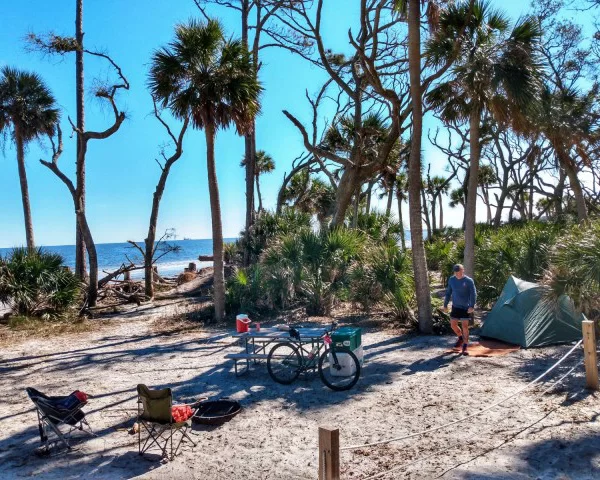
Fall temperatures in the South Carolina Lowcountry are perfect for spending time in nature. The cool mornings, mild days and campfire-worthy evenings are ideal for camping. Spending time outdoors is a wonderful way to escape the grind and recharge the batteries!
Is summer heat too much for you? Do mosquitoes and no-see-ums send you running for the door? Fall is the perfect time for you! Reservations are easier to find after Labor Day when schools are back in session. Temperatures cool, humidity drops, and pesky biting insects begin to disappear.
Load the bikes and head to Pinckney Island to spend the day. Image by SC Lowcountry Tourism Commission.
Three state parks in the Lowcountry have camping facilities. Private campgrounds are also located across the area. While some are designed as destinations, others are perfect for a short stop during a long haul. Campgrounds located along I-95 are great for using as a hub to visit all the major attractions across the Lowcountry.
Canoe or kayak at Sargent Jasper Park, located beside Camp Lake Jasper in Hardeeville. Image by SC Lowcountry Tourism Commission.
Beaufort County
Hunting Island State Park is the South Carolina’s most popular state park. The campground is located at the northern end of the island. The campground has 100 campsites with water and electrical hookups, shower and restroom facilities, beach walkways and a playground.
Image by Bigfoot Search Party.
Image by Cruise America.
Image by the Dyrt.
Enjoy the many miles of walking trails that wind throughout the park. Climb the state’s only publicly accessible lighthouse. Ascend the 167 steps for a panoramic view 130 feet above the beach and maritime forest. The park also has a fishing pier and visitors can borrow gear from the Nature Center.
Image by Cruise America.Image by Sabrina Dutton.Image by Sabrina Dutton.
Hunting Island State Park camping reservations must be made for a minimum of two nights. To make a camping reservation or view current rates, call toll-free 1-866-345-7275, or visit our reservations page by clicking here. Rates vary by season and demand and are subject to change. The campground is pet-friendly, but there are restrictions. 2555 Sea Island Pkwy., Hunting Island, SC 29920
Tuc in the Wood Campground and RV Park is located not too far away on St. Helena Island, one of the Lowcountry’s most beautiful islands. The campground has 80 RV and tent sites with water and electrical hookups. There’s also a bathhouse with hot showers and restroom facilities.
Image by Diane Venuti.Image by Ed Schuler.Image by JJ Liebel.
Cast your line in the stocked, freshwater fishing pond. Visit nearby Penn Center, Chapel of Ease, and Fort Fremont. Travel 12 miles to Hunting Island State Park or drive to downtown Beaufort. Cable TV hookup and Wi-Fi are available. The campground is also pet-friendly. Make your reservations by calling 843-838-2267. Questions and inquiries can be emailed to tuckinthewood@islc.net
Image by Bridget Fitzgerald.Image by Marijo Ahnger.Image by Sarah Runyon.
Hilton Head Harbor RV Resort & Marina is a luxury RV resort located on the north end of Hilton Head Island. The 200-site waterfront, pet friendly resort offers landscaped sites with concrete pads, excellent dining, top-notch amenities, on-site water sports activities and more. The resort has two swimming pools, hot tubs, sun deck, gazebo, saunas, and tennis courts.
Images found on Hilton Head Harbor RV Resort & Marina website.
The on-site marina is the perfect spot to book water sports including jet skis, kayaks, paddle boards, dolphin tours and more. Fish on the pier or launch your boat from the ramp. The property also boasts a 5-Star restaurant. Call 843-681-3256 or visit Hilton Head Harbor RV Resort & Marinafor more information. 43 Jenkins Rd, Hilton Head Island, SC
Images from Hilton Head Harbor RV Resort & Marina website.
Hilton Head Island Motorcoach Resortis a luxury camping destination located on the south end of the island. Guests are provided with the ultimate getaway experience. 400 spacious and charming sites are available to accommodate most motorcoach needs, with full hook-ups, cable TV, Wi-Fi, and excellent amenities. The Resort has spots available to rent or own, including scenic lake front sites, private shaded forest sites, and clubhouse sites that place you steps away from the excitement. The resort is located just one mile from beaches, popular restaurants, and unique shops.
Image by James Cannon.Image by Just a Geek.Image by Charles Williams.
The resort offers an array of amenities including a pool, spa, tennis courts, pickleball courts, dog park and full laundry facilities. Between area attractions and resort events, you’ll always have something fun to do during your stay. Call 843-785-7699 or visit Hilton Head Island Motorcoach Resort for more information. 133 Arrow Road, Hilton Head Island, SC
Image by Wendy Enstine.Image by Glenn WelshansImage by Greg.
Colleton County
Edisto Beach State Park has both oceanfront and salt marsh camp sites. There are 112 sites with water and electrical hookups. Tent campers can choose a site with hookups or a more rustic site at the park’s Live Oak Campground. All sites are conveniently located close to public restrooms with hot showers. The park also has furnished cabins that sit nestled in the woods. The Edisto Beach State Park Campground is pet friendly, but dogs are not allowed in the cabins or cabin area. Dogs must be always kept on a leash. Fishing is allowed along the ocean or salt marsh. Flounder, whiting, spot tail bass and other saltwater fish can be caught in the park. A boat ramp and dock can be found at the park for fishing in Big Bay Creek.
Image by Barbara HatlabanImage by Cat Barber.Image by Crystal Golden.
On warm fall days, spend the day at the beach. Walk along the surf to search for seashells and shark’s teeth. Hike, bike or bird watch along the trails, beach, and maritime forest. The trails are comprised of a series of short, mostly level paths that wind through Edisto Island’s maritime forest of live oak, hanging Spanish moss, and palmetto trees. During your walk you may see white-tailed deer, osprey, or alligators, and may even catch a glimpse of the wary bobcats. To make a camping reservation or view current rates, call toll-free 1-866-345-7275 or visit the reservations page by clicking here. Rates vary by season and demand and are subject to change. Camping reservations must be made for a minimum of two nights. 8377 State Cabin Rd, Edisto Island, SC
Image by Danie Becknell.Image by Thomas Gigliotti.Image by TNVolsFan1969.
Colleton State Park is a paddler’s paradise This Lowcountry park sits a short distance from I-95 and connects to Givhan’s Ferry State Park via 23 miles of blackwater river. Colleton State Park provides easy access to the Edisto River, one of the longest free flowing, blackwater rivers in the country, and serves as the headquarters for the Edisto River canoe and kayak trail. Other amenities at Colleton include an easy nature trail, a campground, picnic shelters and ballfields. The main roads at the park and in the campground are paved.
Image by Maryann F.Image from Colleton State Park website.Image by Jason P.
Each site is packed sand and has individual water and electrical hookups. Some sites accommodate RVs up to 40 feet, others up to 25 feet. The campground is convenient to restrooms with hot showers. To make a camping reservation or view current rates, call toll-free 1-866-345-7275 or visit our reservations page by clicking here. Rates vary by season and demand and are subject to change. Camping reservations must be made for a minimum of two nights. 147 Wayside Lane, Walterboro, SC
Image by Jon Lugoff.Image found on Colleton State Park website.Image from Colleton State Park website.
If you are a true adventurer and want to get off the grid for a while, grab a canoe from Carolina Heritage Outfitters and paddle to your very own treehouse. Located on the halfway point along a 23-mile canoe trip, the Carolina Heritage Outfitters Treehouses are truly off the beaten path. Camp in style with no electricity. Oil candles and tiki torches light the night. Use the propane stove or grill to prepare your meals. The only running water you’re going to find here is in the river. Bring a cooler of provisions to put in the furnished kitchen. Bring a sleeping bag to place on the bed. An outhouse is provided for your convenience.
Images from Carolina Heritage Outfitters.
Meet the team in the morning to shuttle upriver. Paddle 13 miles to your treehouse. Each treehouse is constructed of local materials and tucked away along the riverbank. Swim in the river. Hike the woodland trails. Then warm yourself by the fire pit. After a good night’s rest, paddle the remaining 10 miles to finish off the trip at the outpost. While on the river, be on the lookout for Great blue herons, owls, egrets, wood storks, pileated woodpeckers, wood ducks, wild turkey, deer, muskrats and raccoon. Visit Carolina Heritage Outfitters website or call 843-563-5051 for more information. 1 Livery Lane, St. George, SC
Image by Courtney Toledo.Images from Carolina Heritage Outfitters.Image by Yvolle Lovvorn.
New Green Acres is a full featured campground, able to accommodate the full range of RV dimensions or types. This is a great place to pull in and spend the night while on the way to other adventures. The campground is located on I-95 and has 106 sites with the longest and widest pull-thru sites east of the Mississippi. Water and electrical hook-ups are available, as well as cable and wireless internet.
Image by Campmore Barkless.Image by Deb Puhl.Image by New Green Acres.
Cool off in the swimming pool. Take the kids to the playground or play with your furry friend in the dog park. Visit New Green Acres website or call 843-538-3450, 800-474-3450 for more information or to book a stay. 396 Campground Road, Walterboro, SC 29488
Image by Deb Puhl.Image by Greg.Image by KE.
Givhan’s Ferry State Park is a natural retreat in the Lowcountry woods. The park sits at the end of the 23-mile long stretch of Edisto River kayaking paradise known as the Edisto River kayak and canoe trail that begins at Colleton State Park. The Edisto River is the longest free-flowing blackwater river in North America. Rent a cabin, bring an RV or tent to this beautiful state park. Full-service camping sites are available with water and electrical hookup. Some sites are hike in only. They are also complete with water and electricity. Grills, fire pits, picnic tables and storage boxes are provided at each site. Clean restrooms with hot showers are centrally located. Hike the trails or bring a kayak and explore the river.
Image by Kurt Schultz.Image by Elizabeth C.Image by Roberto Di Camerino.
To make a camping reservation call toll-free 1-866-345-7275 or visit our reservations page by clicking here. Rates vary by season and demand and are subject to change. Camping reservations must be made for a minimum of two nights. Pets are not allowed in the cabins or the cabin areas. Pets are allowed in most other outdoor areas provided they are kept under physical restraint or on a leash not longer than six feet. 746 Givhans Ferry Road, Ridgeville, SC
Image by Carie Robertson.Image by Gene Dennis.Image by Stevenlibby Newton.
Jasper County
Come to the Point South KOA. Unwind at this 5 star retreat located conveniently just off I-95, near Savannah, Charleston, Hilton Head and Beaufort. Visitors have the choice of RV, tent, or cabin sites. Explore the estates, museums, and beaches of the Lowcountry. You may even choose to stay on site and enjoy the many amenities and serene setting. Glamp in a fully stocked deluxe lodge. Some are even crafted from authentic railroad cars! Enjoy this walk in, walk out experience in place of a hotel. Family fun begins as you check in and check out our activities, like gem mining, backpacks to color, as well as kerchiefs for the pups, a large pool and good old-fashioned fun with tether ball, corn hole, horseshoes, life size chess set and Jenga game at the expanded playground.
Image by Rhonda Griffin.Image by Timothy Alston.Image by Walter Doxey.
There is a large dog walk plus a Kamp K9 for our 4-legged friends. Unwind with a glass of wine from regional wineries. Our newest addition is our own crafted beer from a local brewery. Our own Aria’s Ale is on tap at our full-line Swimming Mermaid Coffee House, which has a full selection of custom roast coffees, latte’s, iced coffees, hot tea and more. Relax and enjoy made-to-order pizza and wings, delivered to your site. Unwind in our Coffee House & wine bar, where we feature a full line of locally roasted coffees as well as a full array of wines. Book reservations by visiting koa.com. Call 843-726-5733 or 800-562-2948 for more information.
Image by Jan T.Image by Gail Hampel.Image by J Hof.
Experience the beauty, relaxation, and the perks of nature at The Oaks at Point South RV Resort. Within 45 minutes of this Lowcountry RV camp, you’ll find attractions like Hilton Head, historic Savannah, Georgia, and the Atlantic Ocean. This campground also boasts a convenient location near Interstate 95, allowing guests to enjoy everything the South Carolina Lowcountry has to offer.
Image by Jeffrey Roach.Image by Dan Frailley.Image by Frank DeLuca.
Back at the resort, guests can look forward to an array of activities. Test your hand at mini golf, go for a swim, enjoy fishing, or hit the trails for a hike. Fall activities include Halloween trick or treating and a Thanksgiving potluck. They’re pet friendly as well, so don’t forget your four-legged friends! Call 843-726-5728, or 1-800-388-7788 or visit thousandtrails.com for more information and to book reservations. 1292 Campground Road, Yemassee, SC
Image by RLynn Robertson.Image by T&T Cruises.Image by The Corinthian.
Camp Lake Jasper is conveniently located just minutes off of Interstate 95 at Exit 8 in Hardeeville. This brand new resort is convenient to Hilton Head and the historic cities of Bluffton, Beaufort and Savannah. Wake to the sounds of nature beckoning you to explore the park. Hike the pristine trails, paddle the clear waters, play the challenging “Sarge” disc golf course, or simply relax in the lakeside pool and amenity center. Do as much or as little as you like.
Image by Cameron Keegan.Image by Dick Burgman.Image by Troy Johnson.
Spend the day golfing, shopping, dining, or enjoying the beach and then return for a relaxing night by the campfire. Whether its adventure you seek or escaping the hustle and bustle of everyday life, Camp Lake Jasper is the place for you. Reserve your site today and let the memories begin. 44 Camp Lake Drive, Hardeeville, SC
Image by Brian McMahon.Image by Cameron Keegan.Image by Dancer Doggie.
The park has many prime picnic spots.Image by Carie Robertson. The park is a part of the 23-mile Edisto River Canoe & Kayak Trail. Image by Steven Newton. An interpretative map charts the trail along the Edisto River. Image by Fay and Rose.
Givhans Ferry State Park is nestled along the Edisto River. It’s the perfect place to get away from the hustle and bustle of everyday life. Camping spots and cabins are available for rent. Four cabins with screened back porches overlook the river. Separate sites are available for tent, RV and primitive camping. There’s even a riverfront hall that’s available for events. The hall was built during the Roosevelt administration during the Great Depression as a part of the New Deal Program. As a matter of fact, the entire park was created by the Civilian Conservation Corps, which provided jobs during the 1930’s which addressed the need for the country to conserve natural beauty and create recreational spots to enjoy nature.
Lodging options range from primitive campsites to RV sites and cabins. Photos by Gene Dennis, Rick Johns and Julie Kendall.
Once upon a time, this site was the crossing point for a ferry to move travelers across the Edisto River on the road from Augusta to Charleston. It was named after Phillip Givhan, the area ferry master during the late 1700’s. His granddaughter’s burial site is located on park property. The park’s riverbanks are protected as a Heritage Trust Site.
Experience the Edisto River by water. Photos by 3rd Coast, Lauren Winslow and Roberto De Camerino.
Givhans Ferry State Park is a part of the Edisto River Canoe and Kayak Trail. Bring your gear and have someone drop you off at the Colleton State Park for the 23-mile paddling adventure that will bring you back to the park. The Edisto River is the longest free-flowing blackwater river in North America. View rare plants that thrive along the limestone bluffs as you paddle along the riverbanks. Plan on this trip taking between seven and nine hours.
Hike the River Bluff Nature Trail. Photos by Carie Robertson, Donald Richardson and Jackie Powers.
A hike along the 1.5-mile River Bluff Nature Trail is another good way to see the flora and fauna found at Givhans Ferry State Park. Hike across moderately steep slopes and a canal and overlook the river from the bluffs. View Cypress trees that grow majestically from the river floor. Don’t forget to look for local wildlife along the trail. The trail is an excellent spot for birdwatching.
The Edisto River is a fisherman’s paradise. Photos by Frank Danizik , Margaret Kappel and Marguerite Sterling.
If you enjoy casting a line, fishing gear can be obtained at the park office. The park participates in the Park Loaner Program sponsored by the SC Dept. of Natural Resources. A valid SC fishing license is required. Fish for flathead, catfish, red breast, channel catfish, largemouth bass, striped bass, shellcrackers, blue catfish and eels. Fish from the riverbank or bring along the boat. Access to a boat ramp can be found just a few miles away from the park.
A swim along the shore of the Edisto River is refreshing. Images by Roberto Di Camerino, Ingrid Christensen and 3rd Coast.
Swimming is permitted at the park. No lifeguard is on duty and all swimming is at your own risk. Geocaching is also permitted. Several are located throughout the park. Souvenirs are available at the park store. There you will find t-shirts, caps, mugs, patches and other goodies.
Park buildings were constructed in the 1930’s. The cypress trees along the river have been around for much longer. Hike the park trails to experience the wonders of nature. Images by Chris Tollefson, Daniel Stokes and Elizabeth C.
The park encompasses 988 acres of natural habitat. Amenities include 35 campsites with electrical and water hook-up, four 2-bedroom cabins, and a site for primitive group camping. Two picnic shelters and a playground are also available. The park also has volleyball courts, horseshoe pits and games that are available for check-out at the park office. A Wi-Fi signal can be found at the park office. Make your reservations today to enjoy all that nature has to offer at the Givhan’s Ferry State Park.
Park images by Colleen Evans, Dana Price, Darien Beasley, Sam Taylor, John Jackson and Stuart Steadman.
A trip to Edisto isn’t complete until you visit the Edisto Island Serpentarium. This popular destination offers a wide array of exciting attractions and daily shows. As the first true serpentarium in the state, the facility is dedicated to the recognition, preservation, and study of reptiles. Get up close and personal with alligators, turtles, lizards, and snakes. While some specimens are native to the region, others come from around the world.
The serpentarium has been open to the public since 1999. The collection was gathered by local snake hunters Ted and Heyward Clamp of Edisto Island. A wide variety of reptiles are housed between the modern indoor facility and the beautifully landscaped outdoor gardens. Reptiles can be viewed swimming in streams, climbing trees, and basking in the sun, just as they do in nature.
Two separate ponds house over 20 adult American alligators. Big George, Trouble and Sampson are over 11 feet long. They live and play in Green Pond. Alligator Alley is where you will find the younger, smaller alligators. Peg-leg Pete and Water Dog can be found swimming, sunbathing, and eating in this shady pond. Each spring alligators lay eggs that will hatch in the fall. Babies can be found in the indoor facility. There’s also a nursery between the ponds that houses alligators that are 3 – 11 years old.
Alligators are fed daily when the temperature permits. Visitors get to experience this process up close and personal. Interesting alligator facts are presented during the demonstration along with the history of these prehistoric reptiles.
Turtles also live at the serpentarium. Natural habitat displays are set up for the education and viewing pleasure of visitors. Box turtles, red-eared sliders and diamondback terrapins can be seen, along with Alligator snapping turtles. Two African Spur-thigh Tortoises are also on display. This breed is the largest land turtle in the world.
The serpentarium has beautiful snake habitats. Non-venomous enclosures are home to rat snakes, black racers, coachwhips, water snakes and many more. Observe them as they swim, climb trees and sun on the branches in the large, landscaped open habitat. Venomous varieties are housed separately. Their varieties include cottonmouth moccasins, copperheads, and rattlesnakes.
Educational snake programs are presented daily. Professional handlers explain the value of these animals in their natural environments. Both venomous and non-venomous snakes are discussed.
Different species of lizards can be seen at the serpentarium as well. A bearded dragon and blue-tongued skink, both native to Australia, can be found here, as well as a South American red tegu. The facility has also acquired an Australian Argus Monitor.
Along with the alligator feedings and snake demonstrations, a Keeper’s Choice Show is given each day. Topics vary from tortoises & turtles, lizards, venom extraction and feedings. Be sure to start your visit early in the day so you don’t miss any of the exciting programs and feedings. The modern indoor facility and beautifully landscaped outdoor gardens are awaiting your visit.
The history of indigo production in South Carolina goes all the way back to the birth of our nation and a very special lady named Eliza Lucas Pinckney. The wife of a prominent statesman, Pinckney oversaw the first successful cultivation of South Carolina indigo in 1744. By 1748, indigo was second only to rice as the colony’s commodity cash crop.
Daufuskie Island residents Leanne Coulter and Rhonda Davis run Daufuskie Blues, an indigo dying company that honors this South Carolina tradition. They create eye-catching designs and patterns on scarves, cloth, and other fabrics. The ladies of Daufuskie Blues like to take their show on the road and teach indigo dying workshops around the Lowcountry.
Indigo images found on Daufuskie Blues Facebook.
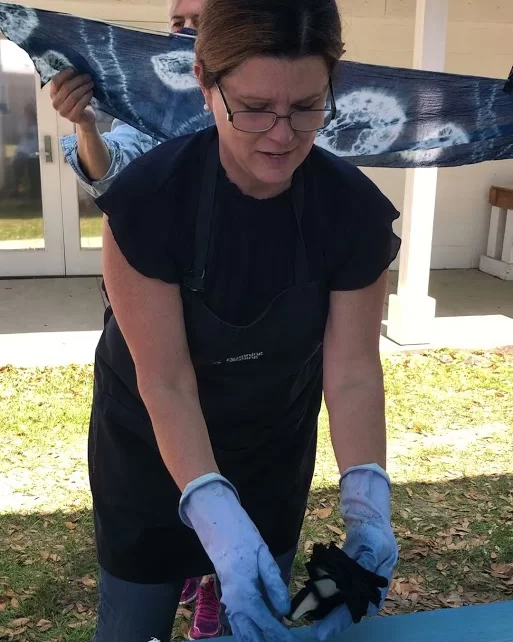
Prior to the late 1880s, the only way to obtain blue dye was with the indigo plant. Leanne and Rhonda take great pride in sharing the history and methodology behind the indigo dying process. Ridgeland’s Morris Center is one of the sites for these classes. The Blues ladies first discussed the history of indigo growing wild on Daufuskie. They also grow it for production. The plant’s leaves are broken down in a reduction vat to make it water soluble. Once the dye is prepared, folded, stitched, twisted or cinched fabric is placed inside the vat. The dye first turns the fabric green. Exposure to the air creates a rich blue hue.
The process always yields a surprise!
After the final soak and rinse the fun really started. Fabric was released from its bindings and all the beautiful patterns were revealed. Each piece was a unique work of art.
Images show the many patterns created during the Indigo dyeing class at Ridgeland’s Morris Center.
Indigo dying classes can be found at Hilton Head’s Coastal Discovery Museum, Walterboro’s Colleton Museum and Ridgeland’s Morris Center. You can also head over to Daufuskie Island and visit with Leanne and Rhonda at their store. Workshops can also be scheduled by appointment on Daufuskie Island.
Images of Daufuskie Blues found on Facebook.
Daufuskie Blues is currently located in the historic Mary Field School, built in 1933, where Pat Conroy once taught. The island and his experiences teaching there inspired him to write his first book The Water is Wide, which was made into the motion picture Conrak. Daufuskie Island is only accessible by boat or ferry. It is one mile south of Hilton Head. Daufuskie Blues is open Tuesdays – Saturdays, from 11 am – 4 pm.
Daufuskie Blues 203 Schoolhouse Road (843) 707-2664, (843)368-3717 leanne.daufuskieblues@gmail.com
South Carolina is widely believed to have one of the most beautiful state flags in the country. The original design was created in 1775 by Colonel William Moultrie, with a crescent shape in the top left corner. This shape and its meaning are topics of great debate amongst the sandlappers of our fair state. Many think it is a moon, others believe it is a gorget. Which is it? What does it signify? Just why is it there? These are the questions that we will ponder in our pursuit of the truth.
Capt. Thomas Hewitt 1781 National Army Museum Study Collection.1772 George Washington by Charles Willson Peale.
One side of the coin
South Carolinians are very egocentric when it comes to their flag. Both schools of thought are also very passionate about their beliefs. State “folklore” suggests the shape is a gorget. Historically they were hung around the necks of soldiers to protect the delicate area from bayonet strikes. They first made an appearance during medieval times. During the 18th century, the gorget could be seen as an accessory on the military uniforms of Revolutionary officers. George Washington first wore a gorget during the French and Indian War to show his rank in the Virginia Regiment. According to Mountvernon.org, George Washington “wears a stylish silver gorget engraved with the royal arms, a vestige of the armor worn by medieval knights, and across his chest he wears a military sash. Both were traditional symbols of rank worn by officers.”
According to the Charleston Museum, “These things have been around in one form or another since the Middle Ages and survive even today within certain military units. Traditionally a component of a suit of armor, the gorget served as a protective plate over the seam between the combatant’s helmet and breastplate. As full body armor became less useful over time, gorgets shrank in size and eventually became a communicative symbol of rank. During the American Revolution, both British and Patriot forces employed gorgets in their uniforms. This particular piece belonged to Charles Cotesworth Pinckney, signer of the United States Constitution and 1803 presidential candidate. The gorget itself was made by master Charleston Silversmith John Vanall circa 1750. (The engraving was very likely done sometime after the war as a commemorative gesture.)”
Cap image from Columbia Star.2nd SC Regiment of Infantry portrait by Lt. Charles M. Lefferts, 1776.
Folklore further says the gorget shape was used on the military caps of the 1st and 2nd South Carolina Regiments during the Revolutionary War. In 1775, Colonel William Moultrie was put in charge of these troops. He was assigned the task of developing a flag for the state while stationed at Fort Sullivan. The flag would be used to signal the city when friendly ships were entering the Charleston harbor. According to some, he used a gorget in the corner of an indigo blue field for this flag. The indigo matched the color of his troop’s uniforms, and the gorget was taken from the cap. Some profess that the word liberty was also written on the flag. The palm tree would later be added to the flag and placed in the center. We’ll talk about that later.
Flag of Fort Moultrie.
The other side of the coin
As previously stated, William Moultrie was the brains behind the design of the flag. In his own words, here’s what he has to say on the matter: “A little time after we were in possession of Fort Johnson [that is, late September or October 1775], it was thought necessary to have a flag for the purpose of signals: (as there was no national or state flag at that time) I was desired by the Council of Safety to have one made, upon which, as the state troops were clothed in blue, and the fort was garrisoned by the first and second regiments, who wore a silver crescent on the front of their caps; I had a large blue flag made with a crescent in the dexter corner, to be in uniform with the troops: This was the first American flag which was displayed in South Carolina.” William Moultrie, Memoirs of the American Revolution, So Far As It Related to the States of North and South-Carolina, and Georgia, volume 1 (New York: David Longworth, 1802)
In this excerpt Moultrie does not offer any explanation about the use of a crescent. The crescent is an ancient symbol that was used throughout history. According to the Hall of Names “the crescent stands for one who has been enlightened and honored by the gracious aspect of his sovereign. It is also borne as a symbol of the hope of greater glory in heraldry. Knights returning from the crusades introduced the crescent, the badge of Islam, into the language of heraldry. The heraldic crescent has a very deep base and curving horns that quickly sharpen to point close together. Crescents also represent the moon that lights the night sky for travelers, though it does not resemble the shape of a crescent moon very closely. In English arms it was also a mark of cadency signifying a second son. The reversed crescent is a crescent with the horns turned down. The term increscent indicated a crescent with the horns facing the observer’s left, and decrescent is a crescent facing the observer’s right.”
Battle of Sullivan’s Island, John White, 1826. Sgt. William Jasper replacing the colors during the British attack on Sullivan’s Island at the entrance to Charleston Harbor, 28 June 1776 colored engraving, 19th century
Did the flag at its conception have a true crescent? If so, the horns would have faced upward. There is some debate about this. This 1826 painting by John Blake White that hangs in the US Senate shows the crescent facing upward. Another painting by Johannes Adam Simon Oertel in 1858 shows the diagonal tilt that we currently use. Both images depict the brave soldier Sergeant William Jasper as he returns the fallen flag to an upright position during the Battle of Sullivan’s Island June 28, 1776. His brave actions rallied the troops to persevere against the British artillery.
Battle of Sullivan’s Island 1844 Granger wood engraving.
This flag became known as the Moultrie flag. The flag was in use at Fort Sullivan (now Fort Moultrie) on June 28, 1776, during the famous Battle of Charleston Harbor. A shell from a British warship damaged the flagstaff. William Jasper recovered the fallen flag and held it in place until a new staff could be installed. This rallied the troops, and they went on the defeat the British. After the war, General Nathaniel Greene presented the flag to the City of Charleston. Although it was intended as a temporary flag, the Moultrie flag was adopted by the colony. It was the first flag to fly over the South. When South Carolina entered the union the Moultrie flag became the official state flag.
The flag remained unchanged until 1861, when the Sabal Palmetto tree was added in honor of Fort Sullivan. The fort was hastily made out of palm trees, that were readily available along the coastline. It was also decreed that the gorget’s tips would forever point straight up as the soldiers had worn it.
Big Red was a flag that was adapted to fly over the Citadel Military College in Charleston.Post & Courier image of Big Red, that flew over Morris Island as the Citadel Cadets fired on Ft. Sumter.
At the beginning of the American Civil War a similar flag was flown at Morris Island by Cadets from the Citadel as they fired upon United States supply ship the Star of the West in 1861. The ship was taking supplies to Fort Sumter. This flag features a reversed crescent, possibly turning away from the Union during the time period of the Civil War.
The flag didn’t change again until 1910, when Alexander Samuel Salley Jr, secretary of the Historical Commission began changing the design. He added more volume to the palm tree and from this point forward, the crescent has been tilted in a northwesterly direction.
Current state laws do not provide specifications of the shape, size, design or placement of the flag symbols, or the exact color of the background. As a result, there are many versions of the state flag. The state’s main universities and their supporters also display the flag in their school colors. A committee of the South Carolina Senate is in the process of picking an official color and design.
Some folks are “Team Gorget”, and others are “Team Crescent”. While minds may or may not be changed from their line of thinking, there are other important aspects to remember. The flag was first designed by a Revolutionary hero. He was held to such high esteem that they named the fort on Sullivan’s Island after him. Colonel William Moultrie’s bravery and leadership will go down in history for all times, as our flag and history books will tell his story forever. The blue will always represent the indigo color of the soldier’s uniforms. The palm will always stand for the strength and fortitude of a quickly built fort, made of readily available sabal palmetto trees, and the waxing moon in the corner will always be an ancient symbol that represents the hope of increasing prosperity and future glory. It further signifies the rising of families or states. And according to Astrotwins and Refinery29.com, the waxing shape in the corner,” …is the cosmos’ not-so-subtle signal to get moving.” That makes sense. Our forefathers did, in fact, “get moving” on Sullivan’s Island that hectic day of June 28, 1776, when they defended their fort against the British for ten grueling hours and held off their attack.
Nestled along the borders of Beaufort and Colleton County, just a stone’s throw south of Charleston and north of Beaufort is the Combahee River. This magnificent river is the spot where Revolutionary War hero Colonel John Laurens died, and Civil War hero Harriet Tubman led over 750 slaves to freedom. Paddling a kayak through this historic estuary is an experience to be savored. The trip is ripe with anticipation of the natural wonders that will be revealed around each bend. The sights, sounds and scents of this Lowcountry paradise never disappoint its visitors.
This image shows evidence of former rice fields along the Combahee River. These fields, dikes and trunk systems are still maintained by landowners to attract wildlife to the area.
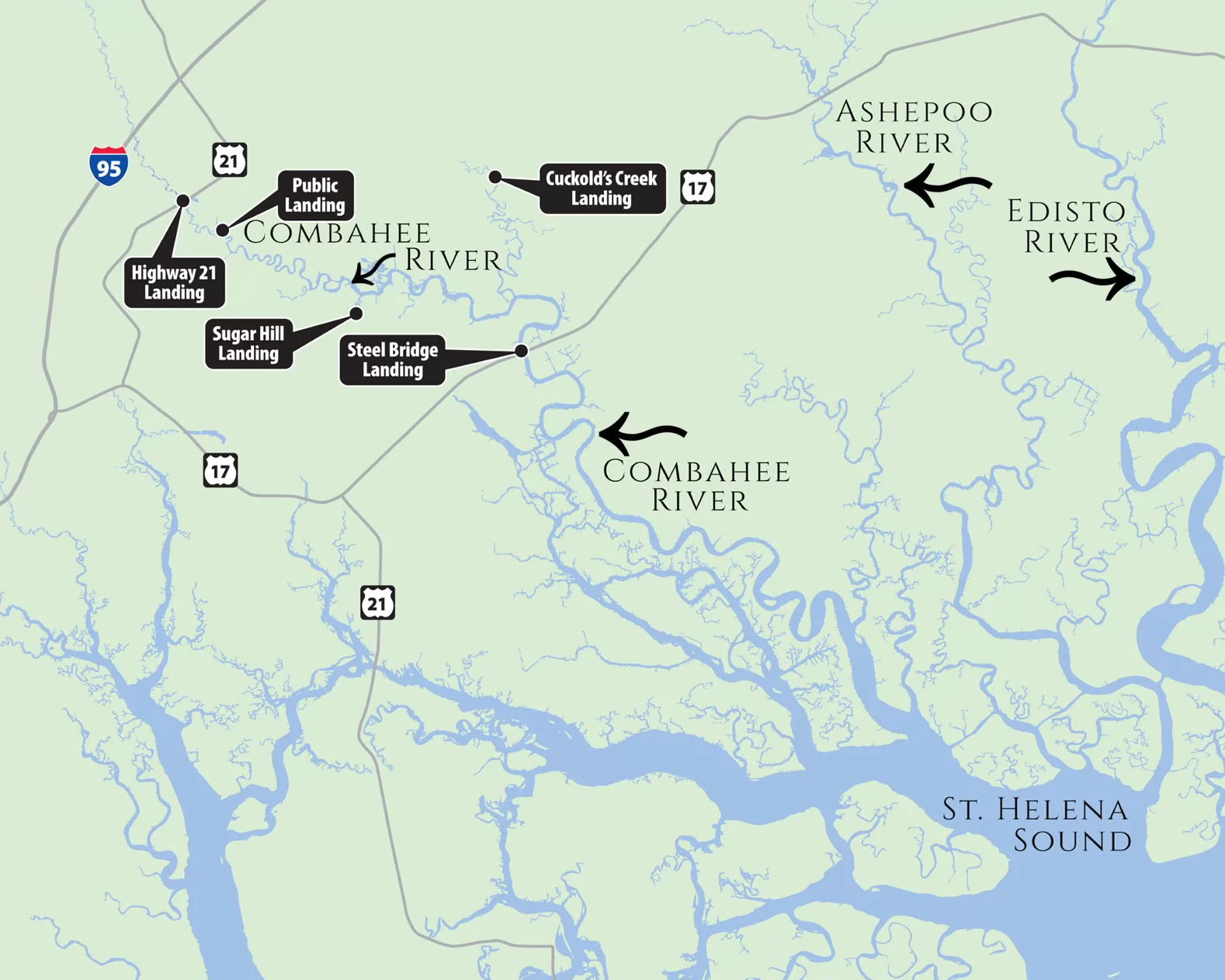
This nature enthusiast’s paradise is a part of the ACE Basin, one of the largest undeveloped estuaries along the Atlantic Coast. The best way to see this blackwater river is in a kayak. Whether you like to explore the river on your own or as a part of a tour, the Combahee has options for you. If you are the adventurous type, know how to read the tides, and have your own kayaks, Cuckhold’s Creek is a great option. If you would rather go with a guide that does all the heavy lifting, Sugar Hill Creek is the place for you. Both creeks provide stunning views of wildlife and evidence of historic rice cultivation.
Beaufort Kayak Tour guides provide an excellent tour of the estuary. Images by Carmen Pinckney.
Beaufort Kayak Tours leads a 2.5-hour excursion from Sugar Hill Landing. This spot is surrounded by former rice plantations just off River Road, via Highway 17. Guides provide a narrated natural and cultural history tour along the scenic waterway which passes rice trunks, and slave-dug canals that were used to flood rice fields. The guides provide everything you need to have a safe and enjoyable journey. Kayaks, paddles, and life jackets are waiting when visitors arrive.
Modern rice trunk systems are still maintained the same way they were in the 1700s. Images by Carmen Pinckney.
The tour proceeds down the creek and into the Combahee River. Historic rice fields are pointed out. Rice fields, dikes and trunk systems that were first built in the early 1700s are still maintained and in use as wildlife management and conservation areas. The formerly cultivated fields are prime habitats to attract all forms of birds and other wildlife species.
Images by Matt on Flickr. His images and description of paddling Cuckhold’s Creek are spectacular.
If you are of a more adventurous type and like to kayak without a guide, Cuckhold’s Creek is the perfect spot for you! This peaceful creek is travelled by many who launch from Cuckhold’s Landing at the intersection of White Hall and Combahee Roads. If you head upstream, you will travel under a bridge used in the filming of Forrest Gump. This creek also shows signs of former rice plantation days. The creek habitat is home to many flowering plants and wildlife.
Views of the Combahee River by Carmen Pinckney. Paddling image by Matt on Flickr.
The very bravest of Lowcountry kayakers enjoy launching from Cuckhold’s Landing and travel into the Combahee, through the rice canals and end the trip at the Steel Bridge Landing. This is a very long trip and not for the faint at heart, especially if the tide changes. Have someone pick you and your gear up from the Steel Bridge.
Plan your kayaking trip during the spring or early summer to see flowering plants along the banks. Images by Carmen Pinckney.
Springtime trips down the Combahee will reward you with floral beauties, including pontederia and rare spider lilies. Butterflies are also drawn to the beautiful blooms along the banks. Water lilies fill the canals and tributaries that branch from the river. Osprey, anhingas and double-breasted cormorants can be spotted in the trees. Egrets and herons can be found wading along the riverbanks. It’s always a good idea to bring along a camera to capture wildlife images. Keep it stowed away in a ziplock bag until you need it. Also, plenty of water and bug spray are also good to pack for the journey.
Water lilies fill the canals and tributaries along the river. Osprey nests can be found high in trees along the banks. An anhinga sits above the river, searching for its next meal. Photos by Carmen Pinckney.
As you travel down the Combahee River and its tributaries, it’s important to reflect on the history of the area. It’s also noteworthy to look for any straight waterways that can be found throughout the estuary. These canals were hand dug by slave labor to supply water to the ancient rice fields. The rice trunks control the flow of this water. Harriet Tubman was stationed in Beaufort with the Union Army for a time during the Civil War. Under the direction of Colonel James Montgomery, she led a scouting party of eight soldiers up the Combahee River to gain intelligence for the union. They burned plantations and liberated over 750 slaves along the river.
Pick your path to Kayak the Combahee River.
Directions for Kayaking Cuckhold’s Creek
The best time launch is on the early falling tide. The landing is accessible via Highway 17. In the Green Pond area, turn onto White Hall Road. Take the first left off White Hall. Launch your canoes then have someone pick you up at the Steel Bridge Landing (Harriet Tubman Bridge). Spring kayakers can get up close and personal with flowering plants, including white spider lilies. The creek travels through historic rice fields of the former Combahee Plantation.
Several bends into the trip, the creek seems to split into different directions. Keep to the right. Just after you pass the White Hall landing, (1.5 miles into trip) the creek splits and forms Folly Creek. Stay to the right to continue on Cuckold’s Creek. The creek will spill into the Combahee River. Stay to the left to continue downstream. The river winds through the marsh. The Steel Bridge Landing will be on the right, just before the Harriet Tubman Bridge.
Both landings can be accessed from Highway 17. Sugar Hill Landing is just off River Road. Cuckhold’s Landing can be found at the intersection of White Hall and Combahee Roads.
It all started with a mini horse named Tilly! Then along came Eddie the mini donkey, Cherokee the rescue horse, chickens, goats, and alpacas!
The entrance to the farm is on Sullivan’s Ferry Rd, just off Highway 17-A in Cottageville. Pearl the alpaca enjoys meeting visitors. The herd loves to romp and roll in the sunshine.
Herd it Here Farm is located in Cottageville, just off Highway 17A. It is a one-of-a-kind educational farm experience. Owners Bill and Sheryl Power established this farm to share their extensive knowledge and love of animals. Visitors get up close and personal as they learn about the unique traits and offerings of each of the farm animals. Activities, workshops, classes, and goat yoga are also in the works.
Visitors get up close and personal with the farm animals as they learn about their life and history on the farm.
The tour starts at the barn where Tilly, the mini horse is introduced. She looks like she trotted out of the pages of a fairy tale. She was a birthday present for Sheryl while the couple were living in Pennsylvania. Eddie the mini donkey came along next when he was just a baby. He and Tilly are excellent pasture mates. These two share space with a horse named Cherokee that was found in Louisiana.
Alpacas are very friendly and well-behaved animals. They are very patient with visitors.
The alpacas are just next door on the other side of the barn. Alpacas are raised for their soft, luxurious fleece. They are related to camels and llamas, but they are much smaller. The Herd It Here Farm alpacas are very curious and friendly. They also enjoy a good sprinkle from the water hose on a hot day.
Lucy and baby Dennis take a nap in the barn. Valerie shows her curious side. The alpaca herd goes outside for a spray from the water hose.
Alpacas are quiet, docile animals. They are safe and pleasant to be around. They each have a very distinct personality. Pearl is very patient and loved being a part of the educational process. Dennis the baby is curious and spunky. He likes to stay close to his mom Lucy. She’s a little shy but likes to pay attention to what’s going on. Valerie is new to the farm but likes to stay close to Pearl. The farm also has two other alpacas, Vickie and Gidget. They were off the property for the day.
Alpaca fleece is woven into yarn that is made into different grades of yarn. It is very soft and warm.
Alpacas are smart and easy to train. Each year their fleece is trimmed and used to make yarn. Each shearing produces between 5 and 10 pounds of fleece. This fleece is comparable to cashmere. It can be made into blankets and apparel.Fancy chickens roam the chicken yard at Herd It Here Farms. Dolly Parton is partial to cuddles and taking naps in the arms of visitors. Eloise sports a crown of white plumage.
Our next stop was to the chicken coop. Fancy chickens roam in their protected space. Silkie chickens have fluffy plumage that is incredibly soft to the touch. They also have five toes, where most other chickens have only four. This breed is very gentle. Cochins are friendly birds with lots of fluff and feathers. Polish chickens have a great crest of feathers that covers almost the entire head. Houdan chickens have a very distinct poofy crown of feathers.
Daryl the fainting goat loves kisses. The pygmy goats enjoy play time. Daryl and Chuck grab a snack.
The goats are the next stop after a visit with the feathered friends. Pigmy and fainting goats romp and play together in their pen. The pigmy goats ate a snack fed by Bill while we learn about and feed the fainting goats. They don’t actually faint. They have a characteristic that makes them freeze and tumble over when they get scared. Daryl the black and white fainting goat loves to eat treats and give kisses. Chuck the brown fainting goat is a little shy but will hand feed. Molly is almost solid black. She has mesmerizing blue eyes.
The gift shop has a variety of things made from alpaca, as well as other locally made products.
The tour ends at the Country Store where alpaca fleece items are on sale. Goats milk lotion and soaps from a neighboring farm are also available, as well as sweetgrass baskets and other goodies. Picnic tables with umbrellas are available for those that bring lunch.
The animals at Herd It Here Farm await your visit.
The farm is currently open for tours on Saturdays and select weekdays by appointment only. Visit the Herd It Here website to schedule a tour or activity. This is a wonderful opportunity to meet all the animals up close and personally, and really learn about them. Tours must be pre-booked and are available at either 10 am, 11:30 am or 1:30 pm.
Herd it Here Farm 541 Sullivan’s Ferry Road Cottageville, SC (703)597-4839
Spend a relaxing afternoon at Hunting Island’s Marsh Boardwalk Trail. Photos by Carmen Pinckney.
Hunting Island State Park is one of South Carolina’s most popular parks. The park’s Marsh Boardwalk offers visitors just over a half-mile of exploration along the southern end of the island. The trail leads deep into a salt marsh hummock area. This maritime forest is home to many species of wildlife. It’s also the island’s prime spot to catch a sunset.
Boardwalks lead to hard packed ground and onto more boardwalks along the main path of the Marsh Boardwalk Trail. Photos by Carmen Pinckney.
This nice, easy nature walk is perfect for all skill levels. Parts of the trip are very accessible for wheelchairs. The trail is a mixture of boardwalk and crushed, hardened surface. Smaller trails that branch off the main trail are too narrow for wheelchairs.
The tidal creek at the end of the Marsh Boardwalk flows into the Atlantic Ocean. Photos by Carmen Pinckney.
Views of the river can be seen from the dock at the end of the trail. Nature talks and tours are given along this trail by park rangers. Contact the nature center for more information.
The Pinckney Doodles love playing in the marsh and relaxing in the shade at the Marsh Boardwalk. Photos by Carmen Pinckney.
Dogs are very welcome on the trails of Hunting Island. Just make sure to keep them on a leash and pick up anything that they deposit along the trail. Don’t forget to pack water for your furry friend. Bug spray is good to have along as well.
Sunset images by Sherri Graham and
A river dock sits at the end of the trail. This is the perfect spot to catch the sunset. Be on the lookout for deer, fiddler crabs and all kinds of birds along the walk.
The Hunting Island Marsh Boardwalk sits just past the entrance to the state park on the right side of Highway 21. The boardwalk is a great place to view the salt marsh area surrounding the final stretch of the highway.
The Combahee River is Colleton County’s freshwater river of paradise
The Combahee River is a Lowcountry blackwater jewel. It is a 40-mile river that is influenced by the tides. The Combahee joins with the Ashepoo and Edisto Rivers to form the ACE Basin. The river gets its name from the Native American tribe that first inhabited the area. It’s the place where Henry Laurens died during the last fight of the Revolutionary War, and the spot where Harriet Tubman rescued over 750 slaves during the Civil War’s Raid at Combahee Ferry.
The Combahee River is a pristine marshy waterway that dumps into the Atlantic Ocean. The river begins life as a freshwater river at its headwaters in Colleton County. It becomes brackish as it nears the salty waters of the Atlantic. It’s a relatively short and narrow river, but it packs a powerfully beautiful punch. Its water, banks and skies are home to wildlife and flowers in bloom.
Local anglers will tell you its home to all breeds of bream that swim in South Carolina waters. The fish can be found under lily pads fallen trees and near cypress knees. This little Bluegill Bream was caught near Public Landing, then released. It’s a good idea to come prepared with a trolling motor and be on the lookout for shallow depths if heading upstream.
The water turns brackish near Steel Bridge Landing. Fresh and saltwater fish can be found in this area. Redfish and flounder have been known to show up here and further down near St. Helena Sound. Speckled trout frequent the salt waters of the sound as well.
Combahee River Boat Landings Highway 21 Landing – Hwy 17A, Yemassee (1 launch, no dock) Hampton Public Landing – Public Landing Rd, off 17A (2 launch lanes, dock) Colleton Sugar Hill Landing – 40 Sugar Hill Landing Rd, Yemassee (1 launch, no dock) Beaufort Steel Bridge Landing at Harriet Tubman Bridge – Charleston Hwy, Yemassee (2 launch lanes, dock) Beaufort Fields Point Landing – Fields Point Lane, Green Pond (1 launch, no dock) Colleton
See what our visitors love about the
SOUTH CAROLINA LOWCOUNTRY
Use the #hashtag #sclowcountry to get your image featured!
The Lowcountry & Resort Islands Region of South Carolina includes the four, southern-most counties in the state, Beaufort, Jasper, Hampton, and Colleton, which are bordered on the east by the Atlantic Ocean and on the west by the Savannah River and the state of Georgia.
Headed down the road....Edisto Island. #edisto #sclowcountry #trees #endofday #beauty #islandsofsc
Discover at your own leisure at the coastaldiscoverymuseum 🌳 From century-old buildings with storied pasts, to wooden boardwalks that stretch into the Jarvis Creek salt marsh, there`s always something to explore!
Pregnancy sleep = 😫. Silver lining, a sunrise walk with Sullie and Zoey. _ Anyone else deal with terrible sleep in the third trimester? It`s been brutal. Combo of overall anxiety/mind racing, digestion discomfort and having to pee all the time! 😐 _ #sunrise #follybeach #sclowcountry #scbeaches #goldenretrievers #goldensofinstagram #charleston #29weekspregnant #thirdtrimester #pregnancylife #pregnancyproblems #beach #beachsunrise
The shore gently recedes beneath the stunning Pawleys Island Pier. The unique island town, located about 25 miles south of Myrtle Beach and 70 miles north of Charleston, exudes laid-back, beachy vibes. Locals have definitely adopted an island state of mind and encourage visitors to as well. When you go, make sure to relax on the beach, explore the famous sand dunes, or fish in one of the many adjacent creeks.
⏰ Best time of the day to visit: We guarantee that you’re going to want to spend a whole day here. We recommend getting to the beach at around 10am.
🗓️ Best time of the year: Pawleys Island has the best weather during the spring and early summer months.
🏖️ Things to do while there: Pawleys Island Nature Park, Pawleys Island Chapel, Hopsewee Plantation.
🐠 Things to visit in the area: Brookgreen Gardens (brookgreen_gardens), take a walking ghost tour, Myrtle Beach (mymyrtlebeach), Harborwalk Marina, South Carolina Maritime Museum (southcarolinamaritimemuseum).
🏨 Where to stay: The Oceanfront Litchfield Inn (oceanfrontlitchfieldinn), Litchfield Beach and Golf Resort (litchfieldbeachandgolf), Sea View Inn (seaviewinn), 620 Prince (620prince).
Details ✨ • I love the perspective of this first shot. I know the angle isn’t a normal view, if you had this hung in your house, but I just think it’s so badass and cool and it’s my account so I can post it and y’all will just have to deal 😆😜. But really, thanks for all the love you’ve shown me on this piece so far. I’m really proud of it and can’t wait to make more versions of this design. 💙🌾 • Fiber sources tagged 🌊
Angel Oak, Johns Island, South Carolina. ⠀ ⠀ The Angel Oak Tree is a Southern live oak (Quercus virginiana) located in Angel Oak Park on Johns Island near Charleston, South Carolina. The Angel Oak Tree is estimated to be at least 400 and possibly up to 1400 years old It stands 66.5 ft (20 m) tall, measures 28 ft (8.5 m) in circumference, and produces shade that covers 17,200 square feet (1,600 m2). Its longest branch distance is 187 ft. in length. ⠀ ⠀ #angeloak #angeloaktree #southcarolina #johnsisland #charleston #DiscoverSC #lowcountry #SCLowcountry #lowcountrylife #igerssouthcarolina #blackandwhite #b&w #oaktree #legacyoak #blackandwhite #blackandwhitephotography #totravelistolive #travel_captures #travellove #travelpics #travelpic #travelbug #travelandlife #lifeisajourney #adventuroussoul
The South Carolina Lowcountry Guidebook is filled with many things to see and do in the beautiful Lowcountry of South Carolina. Please fill out the information and we will send you a FREE GUIDE BOOK.